Do you favor margin or revenue?
Is an Appointment-Only Shop Schedule Wise or Madness?
read more



Do you favor margin or revenue?
Years ago I was scrolling Reddit and stumbled onto one of the most oddball stories I’ve ever seen, and I was sure it was a joke. A guy had worked at a carnival that ran a game called “Frog Bog,” where you hammer a lever to catapult little rubber frogs onto moving lily pads. When the game got scrapped, he took a frog home as a souvenir. He set it on top of his TV and forgot about it. About ten months later he went to peel it off and found it had eaten a hole straight through the plastic casing of the television.
No heat gun. No solvent. No flame. Just a rubber frog, a TV, and time.
Since this was on Reddit, the comments section was quickly full of debate. A self-described polymers engineer explained exactly what happened, and it’s the same thing quietly happening inside every vehicle in your bay:
That’s our subject: plasticizers. They’re in nearly every car you’ll ever touch, they don’t appear in a single service manual, and they don’t fit neatly into anybody’s mechanical knowledge base. But once you understand them, a whole swath of “why is this plastic doing that?” problems suddenly make sense.
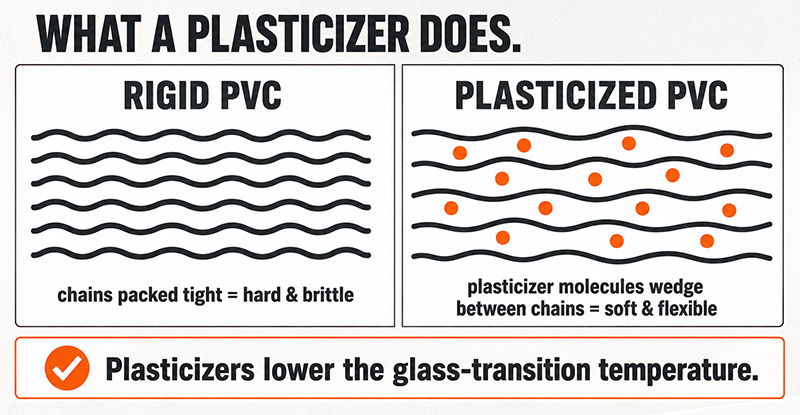
Raw PVC (the same polymer you know from plumbing) is hard and brittle. To turn it into a soft dash pad, a flexible door panel, or a grippy steering wheel, manufacturers blend in plasticizers: small oily molecules that wedge between the long polymer chains and act like molecular ball bearings. They increase the space between chains and lower the material’s glass-transition temperature, the point where a plastic flips from brittle to pliable. More plasticizer, softer plastic.
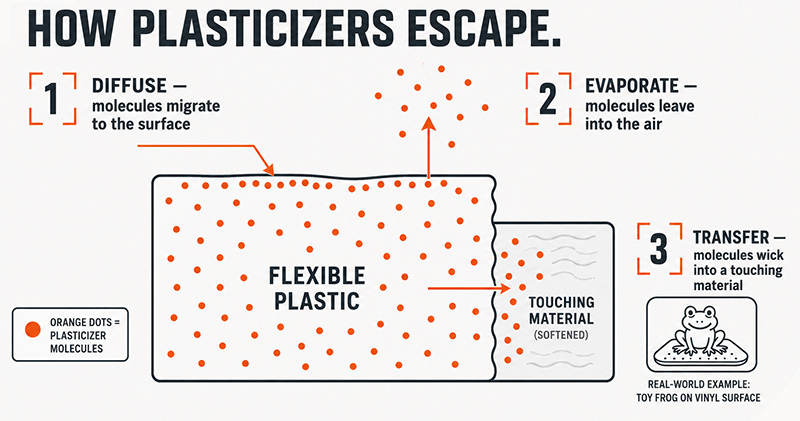
Here’s the catch: plasticizers are not chemically bonded to the plastic. They’re just mixed in. That means they can leave by diffusing to the surface, evaporating into the air, or wicking into whatever material they’re touching. The Reddit frog is door number three: the plasticizer migrated straight out of the frog and into the TV’s casing, softening it until it failed.
For a tech, that one idea explains a surprising amount of what you see every day. The sticky summer steering wheel, the greasy sheen on a dash, the chalky gray bumper trim, and the cracked-to-pieces dashboard are not four different problems. They’re the same process at different stages — plasticizer either coming to the surface or leaving for good.
Plasticizers are almost a century old. Waldo Semon at B.F. Goodrich figured out how to make PVC flexible back in 1926; by the 1930s, plasticizers like DBP and then DEHP (also called DOP) had kicked off the entire flexible-PVC industry. DEHP became the workhorse for decades because it was cheap, effective, and found everywhere from synthetic leather to wire insulation.
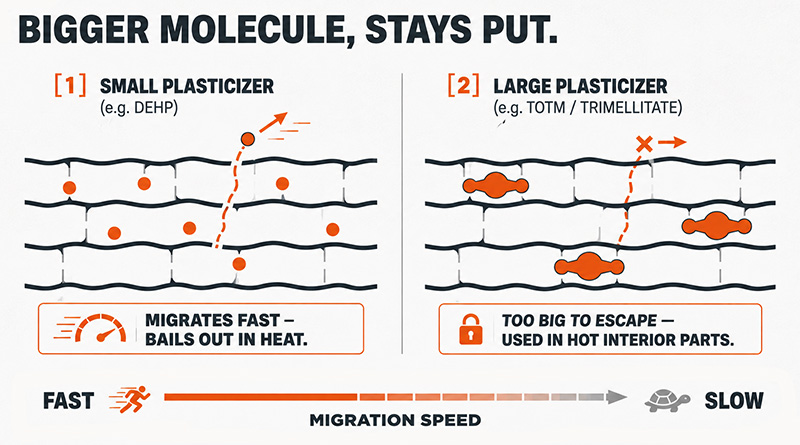
But a car interior is a brutal place for plastic. A dashboard baking behind the windshield can hit 157–200°F (70–93°C), well past where a tiny, unbound plasticizer molecule packs up and leaves. So, the automotive world moved to bigger, heavier, higher-molecular-weight plasticizers such as trimellitates (TOTM), which are rated past 105°C. The logic is simple: a bigger molecule is too fat to wriggle out of the polymer and too heavy to evaporate. It stays where the heat is worst.
Two other forces reshaped what’s in your customer’s dash. First, temperature math: plasticizer migration roughly doubles in speed for every 10°C rise, which is why a dash that’s fine all winter turns tacky in July. Second, regulation: older phthalates like DEHP and DBP got flagged as endocrine disruptors, pushing the industry toward non-phthalate and bio-based options like DOTP and epoxidized soybean oil. The dash of a 2005 vehicle and a 2025 vehicle may look identical and be chemically very different underneath.
So why doesn’t a modern dash simply melt at 190°F the way the frog melted a TV? Because engineers spec the base PVC with a glass-transition temperature around 70–85°C and then validate the finished part with 110–120°C soak tests, building in a safety margin for black interiors and desert parking lots. The plastic is engineered to survive exactly the abuse it’s going to get.
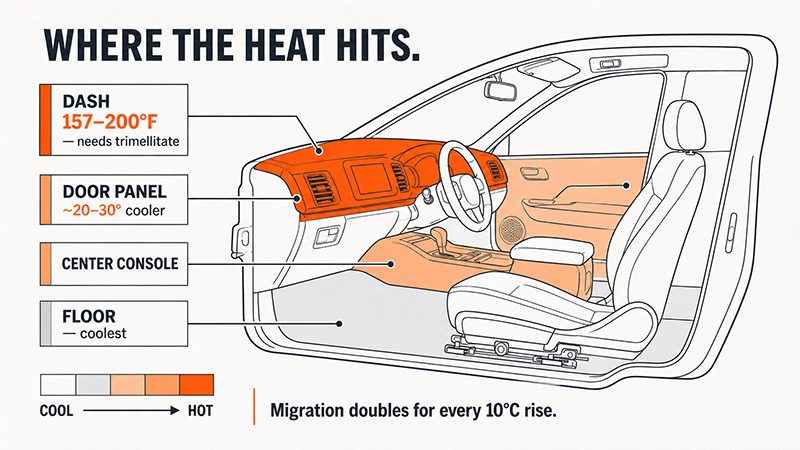
When plastic does fail, it’s usually a one-two punch. Ultraviolet light passes right through the vehicle’s glass and breaks the polymer’s chemical bonds in a process called photodegradation. At the same time, heat drives the plasticizers out. Strip the flexibility away and the material gets stiff, discolored, and brittle. Then thermal cycling finishes the job: a dash that swings from 150°F in the afternoon to near-freezing overnight expands and contracts until hairline crazing opens into spiderweb cracks.
UV is the dominant culprit, and the damage is cumulative and irreversible. This is the single most important thing to tell a customer: once a dash or trim panel has cracked into the substrate, no conditioner, dressing, or coating rebuilds it. You can slow the decline, but you can’t undo the molecular damage.
One field note worth passing along: harsh cleaners speed the decay of plastics. Ammonia- and alcohol-based products strip the surface oils and residual plasticizers, drying the plastic out faster than age alone ever would. The $6 glass cleaner in the door pocket can do real damage to a dash.
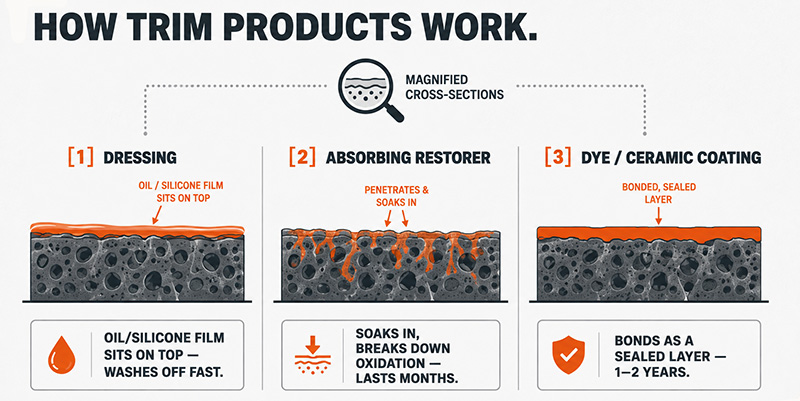
You’ll find dozens of “trim restorers” in the detailing aisle, and they don’t all do the same job. It helps to sort them into three tiers — and to understand that none of them truly re-plasticize the polymer. They work on or near the surface:
The useful question isn’t “which is best?;” it’s “what is this product actually doing?” Are you replenishing surface oil, laying down a sacrificial UV film, or dyeing the plastic? Each answers a different customer expectation and lasts a different amount of time. Set that expectation up front and nobody’s surprised when the $8 dressing is gone after two car washes.
If restoring trim is a chemical process, what’s going on when a detailer waves a torch or heat gun over a faded bumper and it turns black in seconds? It looks like magic. It’s actually the same plasticizer story, run in fast-forward.
The heat briefly melts the thin, oxidized top layer and mobilizes the un-oxidized polymer and oils underneath, pulling them back to the surface. That fresh, oil-rich layer appears deep black again. The color really does come back … for a while.
But here’s the honest part: it’s cosmetic, not a repair. Every pass of the flame that brings oils up also drives some of them off. Do it repeatedly and you’re slowly cooking the plasticizers out of the plastic — drying it, embrittling it, and shortening its life in exchange for a short-term shine. In the best case scenario, you’ll see plastic’s color bounce back without glossing over or burning. This is only possible with gentle heat and constant motion.
(The torch technique is really a last-ditch option because it not only shortens the plastic’s service life, but it can also leave an unsightly finish if you overcook the plastic. That said, it can be worth trying to get a little more life out of tired bumpers and trim pieces.)
The best-practice version treats heat as a prep step, not the finish. Bring the color back, let it cool, then seal it with a quality UV protectant or coating so the surface is protected instead of just briefly refreshed.
There’s one more side effect of automotive plasticizers that we need to talk about. That greasy haze that keeps building on the inside of a windshield, sometimes causing a blinding glare against low sun or oncoming headlights, is also caused by these molecules. Hot dash and trim plastics off-gas volatile compounds; those vapors rise, find the coolest surface in the cabin (the glass), and condense into an oily film. It’s literally the automotive version of the frog: plasticizer leaving one plastic and landing on another surface. The famous “new car smell” is largely this same off-gassing.
It’s a big enough deal that automakers specifically test for it. Fogging standards (SAE J1756, DIN 75201, ISO 6452) bake interior materials in a sealed chamber and measure how much film condenses on a glass or foil lid — with the phthalate DIDP serving as the long-standing reference material. If a supplier’s dash material fogs too much, it fails before it ever reaches production.
Which brings us to the question a sharp tech or customer will eventually ask: should you cover the windshield when you treat the dash? Short answer — yes, be deliberate about it. The detailing and glass-repair world is unanimous on the technique for a reason: spray product onto the applicator pad, never directly onto the surface, and keep overspray off the glass. Silicone dressings and cleaner mist that drift onto the windshield add their own haze on top of the plastic’s natural off-gassing. So, when you dress a dash: mask or drape the glass, apply your dressing to a pad, and give it time to flash off with the windows cracked before you seal the car up in the sun.
And the bottom line on repair vs. replace, the way you’d put it to a customer: if the surface is just faded, chalky, or oxidized, it’s intact — treat it and protect it. Once it’s cracked through into the substrate, the plasticizers that kept it flexible are long gone and they’re not coming back. That one’s a replacement.
A rubber frog melting a hole in a TV sounds like a tall tale. It’s just chemistry! And it’s the same chemistry sitting on top of your dash, wrapped around your steering wheel, and quietly fogging your windshield every summer. Plasticizers are the oils that don’t show up on the garage floor, that’re found in every car and in no manual. Understand where they go and why, and you’ll have a better answer than most for that faded trim, that cracked dash, and that stubborn haze on the glass.
SOURCES / RESEARCH NOTES
Reddit “Frog Bog” post + engineer comment (r/AskReddit); plasticizer function & migration (The Chemical Company; BASTONE); automotive interior heat & plasticizer tiers, TOTM/DOTP/DINP (BASTONE); history of DEHP/DBP/DOP & Waldo Semon (BenchChem; NBInno); dashboard cracking / UV photodegradation (Engineer Fix; CustomFitSunShades); restoration product tiers & torch method (Engineer Fix; Apex Auto Pros; AutoGuide; ShunPoly; GhostFace Workshop); windshield off-gassing & fogging standards SAE J1756/DIN 75201/ISO 6452, DIDP reference (Engineer Fix; True Blue Auto Glass; Intertek; SCHAP).
The articles and other content contained on this site may contain links to third party websites. By clicking them, you consent to Dorman’s Website Use Agreement.
Ever get up to your elbows in a diagnostic problem, only to wind up right where you started an hour later?
Having trouble hanging onto a nut or bolt with a socket?
Are you making any of these three common mistakes?
We all know how to bleed brakes—but are you missing a final step?
How to check the battery and fuses in your DVOM/multimeter to make sure that it’s ready to go for your next job.
Does your customer need a new battery? Learn how to properly test an aging or questionable battery.
Participation in this forum is subject to Dorman’s Website Terms & Conditions. Please read our Comment Policy before commenting.