Shop Press

Shop Press is the news and idea hub for everything related to working on cars and trucks, focusing on repair, technology, and wrenching lifestyle.

From the creative minds at:

FEATURE STORY

Hot Off the Press

ADAS Alignment and Calibration – ASE Practice Question (VIDEO)

Description Technician A says that the thrust angle must be maintained at zero degrees when performing an alignment on many vehicles equipped with certain ADAS systems (like lane departure warning). Technician B says that the steering angle sensor must be properly...

Writers, Print Vehicle Service Histories for Every Vehicle

The fellas who taught me to write service were arguably some of the best I’ve seen do the job. They had all sorts of tricks up their sleeves, like the boomerang business cards you’ve read about before. Today, I’d like to share another tip my friend Sam gave me. It...

The JDM Class of 2001 Comes of Age

Japanese Domestic Market (JDM) cars during their heyday in the 1990s were the unattainable treasure, not for North American consumption, only accessible in video games. They were tantalizingly close but not truly attainable. Turns out all it takes is patience: 25...

Ferdinand Porsche: Engineering the Shape of Speed

Ferdinand Porsche is one of the earliest designers featured in our “Automotive Paragons” series, and few figures loom as large over the modern automotive world. His career began at the dawn of motoring itself, when horseless carriages were still experimental...

Service Writers: Don’t Leave Your Greatest Diag Tool in the Shop

Today’s piece starts with a one-question quiz that’s not a trick question: in your shop, what is your best diagnostic tool? It’s not a meter or a scan tool or a stethoscope, though those all are handy items to have nearby. It’s your technician. And as much as leaving...

PSA: The Right (and Wrong) Ways to Handle Iridium Spark Plugs

by | Feb 24, 2026

For the vast majority of vehicles on the road, swapping out spark plugs is gravy work. Yoink the old plugs, make sure the replacements meet the necessary gap spec, install the new plugs, and button up the ignition system. You’re in and out of there in no time, right?

That may have been acceptable back in the days when practically every vehicle used good ol’ copper core plugs that didn’t care too much about how they were handled or adjusted. Accidentally set the gap a few thousandths off? No biggie, just bend the strap again and verify with your gauge. Easy peasy.

But new techs and DIYers alike should know that the game has changed. Those old methods can create new problems in a hurry, leading to comebacks, driveability issues, and other headaches. And it all comes down to one of the rarest metals on Earth: iridium. Ironically, it’s also one of the most common core materials found in modern spark plugs.
CanAm
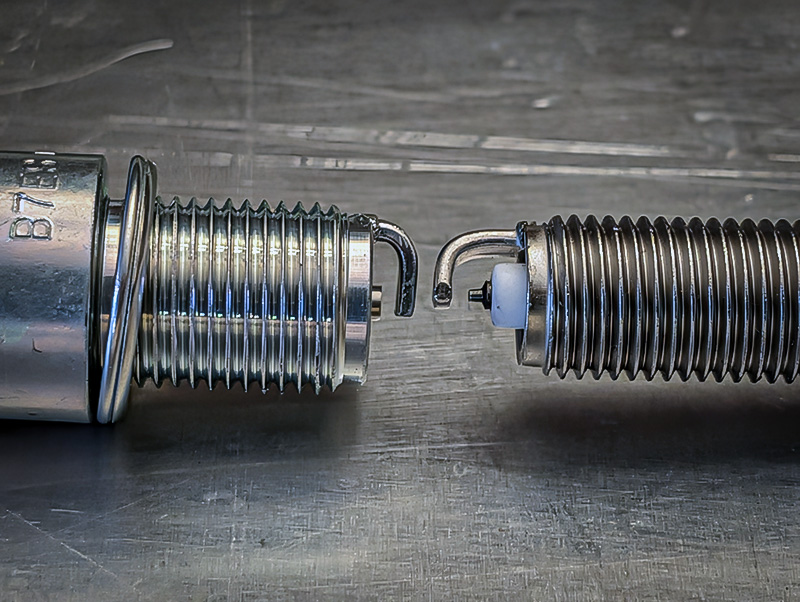
A copper core plug (left) and iridium core plug (right). Note the fine electrode tip on the iridium plug. Photo: Andy Greaser.

While manufacturers spec spark plugs with iridium cores for a few reasons, they are broadly used to squeeze performance out of optimized engine designs, often supporting additional technologies like forced induction, direct injection, and sophisticated ignition systems. So don’t be surprised when you see one, and definitely do not make any of the following rookie mistakes:
  • Don’t touch the electrode. Iridium is brittle, and it doesn’t take much to ruin an electrode.
  • Don’t gap iridium plugs. They are preset at the factory. Simply order the correct plugs from the get-go, and you won’t need to touch your gauge set.
  • Install iridium plugs with care. That goes double for modern engine designs that position the plug deep in the engine to accommodate direct injection. Dropping a plug down a spark plug well can damage the electrode, and if you install that plug, the vehicle may exhibit ignition issues.
  • Related to the point above: make sure your spark plug sockets are in good condition. Most spark plug sockets will have a little rubber ring inside to help hold the plug as you install it. If that donut is worn out or missing, you’ll run the risk of dropping the plug mid-install.
  • It is possible to clean deposits off of iridium plugs, but only a soft brush and isopropyl alcohol should be used. Don’t reach for your wire brush, and absolutely do not use any abrasives. Heavy deposits on a fresh plug requires diagnostic work, or the deposits will probably return quickly.
CanAm
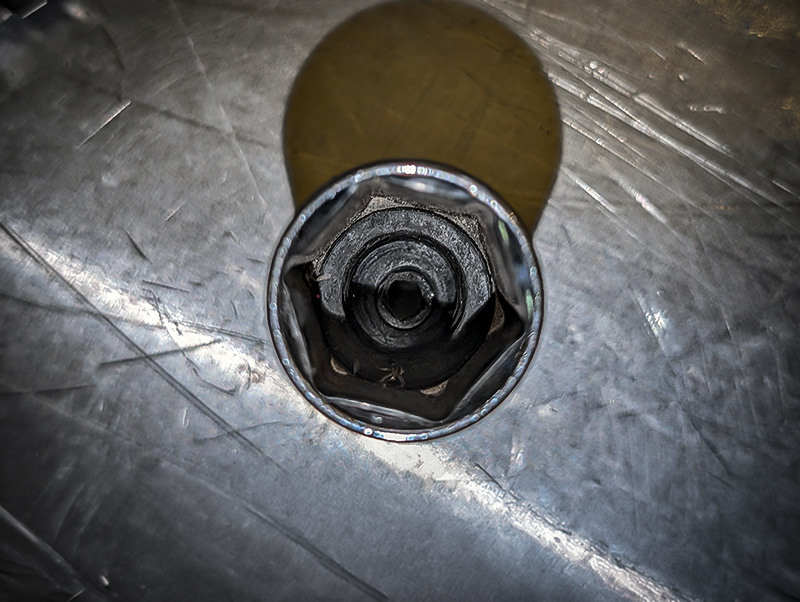
That rubber ring down in the bottom of a spark plug socket helps to secure the plug as you install it. Make sure it isn’t missing or worn out. Photo: Andy Greaser.
So next time you’ve got a spark plug job on your hands, take a peek at the electrode to see if it has the distinctive fine tip of an iridium core poking out. That’s your cue to work carefully and follow the tips above for a successful job.

The articles and other content contained on this site may contain links to third party websites. By clicking them, you consent to Dorman’s Website Use Agreement.

Related Articles

Shop Press Comment Policy

Participation in this forum is subject to Dorman’s Website Terms & Conditions. Please read our Comment Policy before commenting.

Subscribe
Notify of
guest
0 Comments
Newest
Oldest Most Voted
Inline feedback
View all comments